Flue Gas Treatment Systems
Wet scrubber
The intended use of a wet scrubber unit is to remove gaseous pollutants such as SO₂ and HCl from the flue gas stream, as well as to capture particulates.
There are three main wet scrubber types:
- Venturi Scrubbers
- Spray Towers
- Packed Bed Scrubbers
Among them venturi scrubber is mainly used for the particulate removal while the other are used for acidic content removal.
In spray tower and packed bed scrubbers flue gas is quenched with NaOH solution in this tower with the counter-current flow.
Wet scrubber units have quite higher efficiencies on acidic pollutant removal than the dry scrubbers.
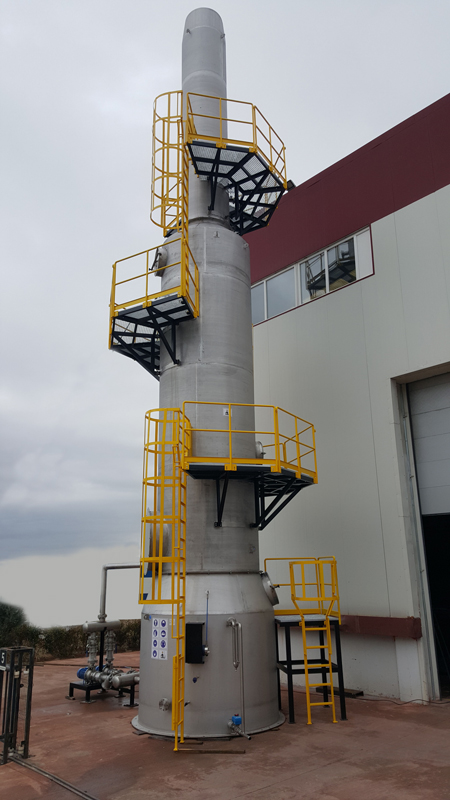
Venturi Scrubber Main Features:
- Able to remove particles with high efficiency
- It has 3 main sections; namely, Convergent section, Venturi throat, Divergent section
- Gas enters from the top of the unit and moves in the same direction with water
- Main removal occurs in the throat section of the unit
- For efficient removal, the gas passes through the stack at very high speed.
- There is a high pressure drop in this unit The main reason is the high velocity difference through the venturi
- Even very small particles can be removed by the venturi scrubber
- In addition to particle reduction, a temperature decrease is achieved in the venturi scrubber.
- It has very high removal rates compared with other treatment methods.
Spray Tower Main Features:
- Made of SS316 or FRP
- Can resist high temperatures
- Removal efficiencies of higher than 85%
- High resistance to acid corrosion
- Water is recirculated to minimize the water consumption and wastewater generation
- The pH of the system is adjusted automatically
- Caustic solution is used as a scrubbing agent
- Lower pressure drop
Packed Bed Scrubber Main Features:
- Made of SS316
- Can resist high temperatures
- Removal efficiencies of higher than 99%
- High resistance to acid corrosion
- Water is recirculated to minimize the water consumption and wastewater generation
- The pH of the system adjusted automatically
- Caustic solution is used as a scrubbing agent
- Flue gas enters from the bottom of the unit and flows upwards
- The water sprayed from the top of the unit flows downward and is recirculate
- Water and flue gas create a countercurrent flow and interact with each other.